
Airdome Installation: Comprehensive Guide
Air domes are revolutionizing the modern construction industry and challenging traditional building methods. These innovative structures stand out for their simple designs, rapid assembly, and striking cost-effectiveness. By 2025, air dome technology will have a wide spectrum of applications, ranging from sports facilities and industrial areas to warehouse construction and even emergency shelters.
The Future of Architecture: Airdomes
What is an Airdome?
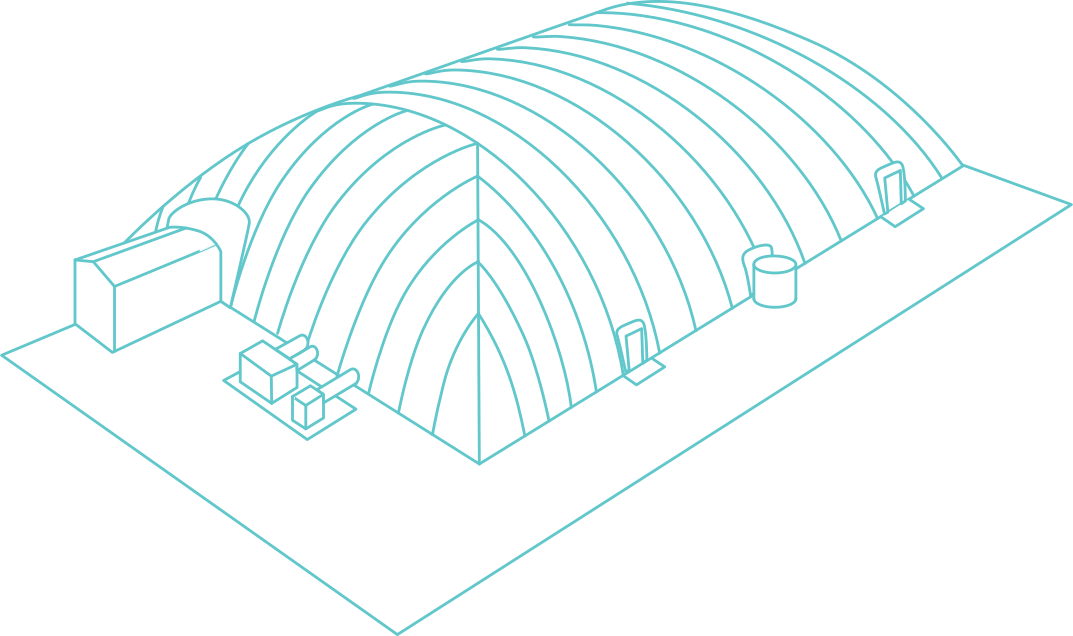
An air dome is an inflatable structure supported by internally compressed air, deriving its structural integrity from this internal pressure. The dome shape is the preferred geometry because it provides the maximum volume with the least amount of material.
Main Structural Components
A typical air dome consists of the following basic elements: Membrane Envelope: The outer shell of the structure is made of synthetic fabric coated with multi-layered PVC or PVDF (polyvinylidene fluoride). This material exhibits high resistance to UV rays, flames, and weather conditions. Climate Control System: Powerful fan systems are used to maintain a constant internal pressure of 200-300 Pascal inside the structure. This pressure difference plays a vital role in keeping the structure stable and upright. Air Locks: Located at the inlet and outlet points, these systems ensure the maintenance of internal pressure and preserve the integrity of the structure.
Anchorage System
The structure is anchored to a cement-based foundation in the ground using anchoring systems. Unlike traditional structures, it does not require complex foundation preparation.
Advanced Membrane Technology
Membrane materials used in 2025 will consist of front-generation fiber combinations: PVC and PVDF Coating: PVC material with PVDF coating can provide up to 25% natural light transmission, reducing the need for daylight illumination while significantly lowering energy consumption by increasing heat reflectivity.
Fire Safety
PVDF material is known for blocking 90% of ultraviolet rays, providing high heat reflectivity and dissipation, and having a B1 (flame retardant) fire classification. Climate Control Capability: Air domes can withstand temperatures between -55°C and +70°C, making them suitable for use in extreme climate zones.
Structural Strength
Modern airdomes are extremely robust: designed to withstand wind loads of 150 mph and snow loads of 1 meter thick, spans exceeding 100 meters can be easily constructed.
Construction Process: Speed and Efficiency
Compared to traditional construction methods, air domes offer a remarkable speed advantage. The full installation process is typically completed in approximately 15 days. Installation Steps Site Preparation: Simple preparation requiring minimal soil tillage.
Foundation Casting: Cement foundation for anchor points
Membrane Placement: Opening and inserting the fabric envelope.
Air System Activation: Starting the fan systems and adjusting the pressure.
Airlock Integration: Calibration of input/output points.
Thanks to their modular design, air domes are easy to assemble, disassemble, and move to different locations. This feature makes them an ideal solution for seasonal facilities or temporary event venues.
Cost Analysis: Return on Investment
Startup Costs
Compared to traditional permanent structures, air domes can save 50-75% on construction costs. However, several factors affect the final price: location and ground conditions.
Anchoring requirements, Service life (seasonal vs. permanent), Customized features, Operational Costs: Air domes have significantly lower operating costs compared to traditional structures.
Energy Efficiency
Thanks to the heat reflectivity of the membrane, air conditioning costs are reduced by 30-40%. Maintenance Costs: Minimal maintenance required. Labor Savings: Less labor required during installation. Payback Period: In commercial applications, the initial investment can be recouped within 3-5 years through rental income.
Life Expectancy
Membrane Lifecycle
The durability of air domes depends on material quality and maintenance:
Single-layer PVC domes: 10-15 years;
Double-layer PVC domes: Up to 30 years;
Permanent PVDF domes: 25-30 years
Seasonal Domes
Typically, after about 20 years, the domes are not replaced entirely; usually only the membrane layers are replaced.
Maintenance Requirements
Air domes are cost-effective due to their minimal maintenance requirements. Regular maintenance and repairs can significantly extend the structure's lifespan.
Sports Facilities
The global market for air domes for sports applications is projected to grow at a compound annual rate of 6.2% from 2024 to 2032.
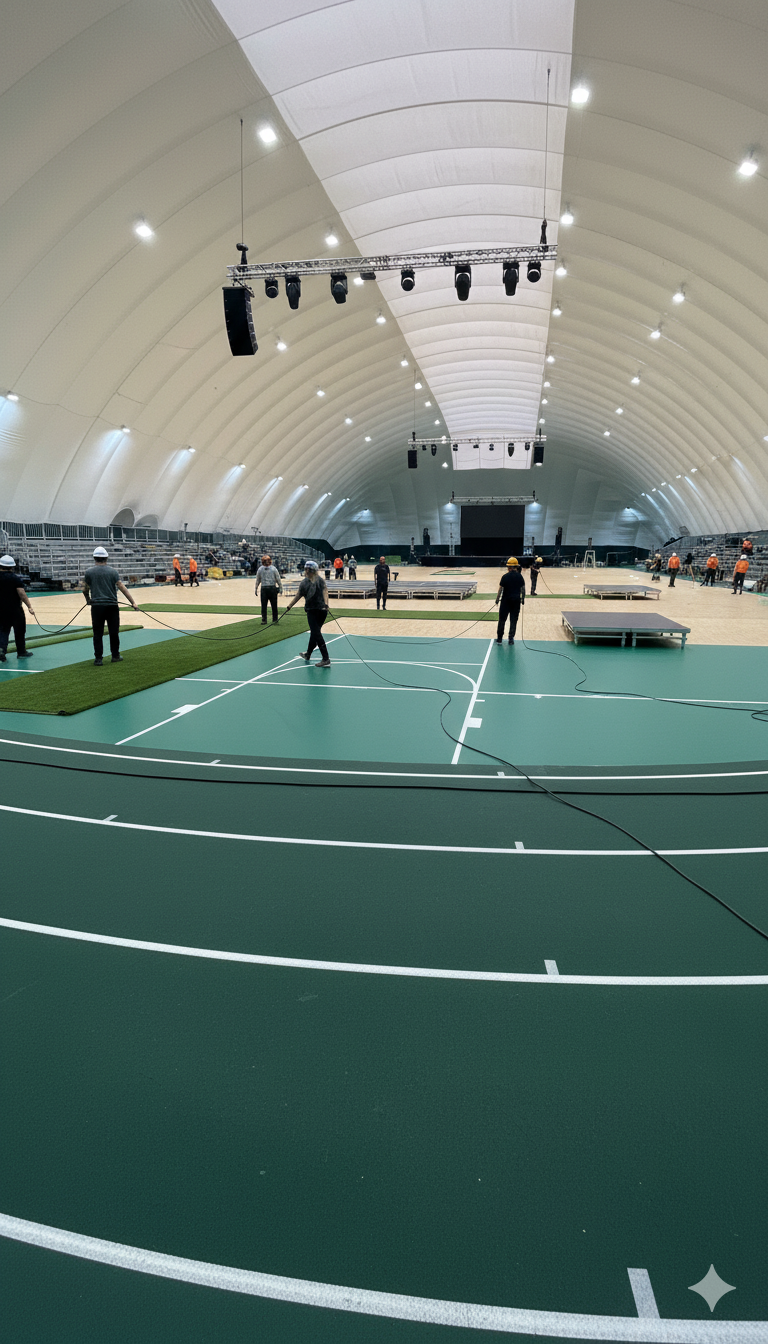
Common sports applications include: Football fields, Tennis courts, Swimming pools, Ice hockey rinks, Indoor athletics facilities, Industrial Warehousing.
Air domes provide an ideal solution for industrial storage without large open spaces. Since there are no supporting columns or beams inside the structure, equipment storage and management are greatly simplified.
Agricultural Applications
Air domes, used as greenhouses, allow farmers to grow crops year-round under controlled conditions. Broadwell air domes have demonstrated the ability to filter nearly 100% of pollutants in most areas of agricultural land, significantly reducing PM2.5 fine particulate pollution.
Emergency and Construction Applications
The latest example from China demonstrates its potential in emergency applications: In Jinan, a 20,000 square meter air dome was used to protect a construction site from dust and debris, blocking 90% of dust, reducing construction noise by 80%, and providing protection from wind, rain, and snow.
Environmentally Friendly Features: Sustainability Advantages
Material Efficiency:
Air domes significantly reduce carbon emissions by using far less material than traditional structures, and the selection of recyclable materials increases environmental sensitivity.
Energy Efficiency: Modern air domes significantly reduce energy consumption throughout the year by using low-energy membrane systems integrated with intelligent climate control systems.
Renewable Energy Integration
Weather domes with 2025 technology: Solar panels can be installed on the dome surface; rainwater harvesting systems can be integrated; and energy independence can be achieved.
Global Market Analysis: 2025-2032 Projections - Regional Leadership
Asia-Pacific Region: The Asia-Pacific region has the largest share of the global air-supported dome market in terms of volume and revenue, with China alone contributing more than 60% of the regional market. North America: North America is a technologically advanced air-supported dome market, with the US and Canada leading in innovation and showing strong demand for specialized applications. Europe: European markets emphasize sustainable construction and energy-efficient designs, showing high demand for winter sports facilities.
Intelligent Control Systems
High-tenacity fabrics are replacing traditional materials with their UV resistance and flame-retardant properties, while integration with intelligent climate control systems has enabled real-time monitoring and optimization of indoor conditions.
Monitoring and Warning Systems
Modern air domes are equipped with 24/7 real-time monitoring, fire alarm systems, and intelligent explosion prevention systems. Users can monitor the system and receive alerts via their smartphones. Automatic Pressure Control: When external conditions related to wind and snow loads change, automatic control systems dynamically adjust the internal pressure setting. Challenges and Future Perspectives: Regulatory Barriers: Air domes are still not considered permanent structures in some areas, giving them an advantage in terms of building permit requirements. However, some jurisdictions may impose strict regulations due to safety and aesthetic concerns.
Future Technologies
Upcoming developments include: Autonomous surveillance systems, Internet of Things (IoT) integration, improved membrane materials, and fully energy-independent designs.
Conclusion: Transformation of the Construction Industry
Air domes are more than just a technology that reduces construction costs or increases assembly speed. They are changing the fundamental paradigm of architecture in terms of creating sustainable, adaptable, and efficient building spaces. By 2025, air domes, already being applied across a wide spectrum from sports facilities to industrial warehouses, agricultural applications, and emergency solutions, are expected to become even more widespread in the construction sector in the next decade. Thanks to the right materials, smart technology, and integrated design, air domes are poised to take center stage in 21st-century architecture.
An air dome is an inflatable structure supported by internally compressed air, deriving its structural integrity from this internal pressure. The dome shape is the preferred geometry because it provides the maximum volume with the least amount of material.
Main Structural Components
A typical air dome consists of the following basic elements: Membrane Envelope: The outer shell of the structure is made of synthetic fabric coated with multi-layered PVC or PVDF (polyvinylidene fluoride). This material exhibits high resistance to UV rays, flames, and weather conditions. Climate Control System: Powerful fan systems are used to maintain a constant internal pressure of 200-300 Pascal inside the structure. This pressure difference plays a vital role in keeping the structure stable and upright. Air Locks: Located at the inlet and outlet points, these systems ensure the maintenance of internal pressure and preserve the integrity of the structure.
Anchorage System
The structure is anchored to a cement-based foundation in the ground using anchoring systems. Unlike traditional structures, it does not require complex foundation preparation.
Advanced Membrane Technology
Membrane materials used in 2025 will consist of front-generation fiber combinations: PVC and PVDF Coating: PVC material with PVDF coating can provide up to 25% natural light transmission, reducing the need for daylight illumination while significantly lowering energy consumption by increasing heat reflectivity.
Fire Safety
PVDF material is known for blocking 90% of ultraviolet rays, providing high heat reflectivity and dissipation, and having a B1 (flame retardant) fire classification. Climate Control Capability: Air domes can withstand temperatures between -55°C and +70°C, making them suitable for use in extreme climate zones.
Structural Strength
Modern airdomes are extremely robust: designed to withstand wind loads of 150 mph and snow loads of 1 meter thick, spans exceeding 100 meters can be easily constructed.
Construction Process: Speed and Efficiency
Compared to traditional construction methods, air domes offer a remarkable speed advantage. The full installation process is typically completed in approximately 15 days. Installation Steps Site Preparation: Simple preparation requiring minimal soil tillage.
Foundation Casting: Cement foundation for anchor points
Membrane Placement: Opening and inserting the fabric envelope.
Air System Activation: Starting the fan systems and adjusting the pressure.
Airlock Integration: Calibration of input/output points.
Thanks to their modular design, air domes are easy to assemble, disassemble, and move to different locations. This feature makes them an ideal solution for seasonal facilities or temporary event venues.
Cost Analysis: Return on Investment
Startup Costs
Compared to traditional permanent structures, air domes can save 50-75% on construction costs. However, several factors affect the final price: location and ground conditions.
Anchoring requirements, Service life (seasonal vs. permanent), Customized features, Operational Costs: Air domes have significantly lower operating costs compared to traditional structures.
Energy Efficiency
Thanks to the heat reflectivity of the membrane, air conditioning costs are reduced by 30-40%. Maintenance Costs: Minimal maintenance required. Labor Savings: Less labor required during installation. Payback Period: In commercial applications, the initial investment can be recouped within 3-5 years through rental income.
Life Expectancy
Membrane Lifecycle
The durability of air domes depends on material quality and maintenance:
Single-layer PVC domes: 10-15 years;
Double-layer PVC domes: Up to 30 years;
Permanent PVDF domes: 25-30 years
Seasonal Domes
Typically, after about 20 years, the domes are not replaced entirely; usually only the membrane layers are replaced.
Maintenance Requirements
Air domes are cost-effective due to their minimal maintenance requirements. Regular maintenance and repairs can significantly extend the structure's lifespan.
Sports Facilities
The global market for air domes for sports applications is projected to grow at a compound annual rate of 6.2% from 2024 to 2032.
Common sports applications include: Football fields, Tennis courts, Swimming pools, Ice hockey rinks, Indoor athletics facilities, Industrial Warehousing.
Air domes provide an ideal solution for industrial storage without large open spaces. Since there are no supporting columns or beams inside the structure, equipment storage and management are greatly simplified.
Agricultural Applications
Air domes, used as greenhouses, allow farmers to grow crops year-round under controlled conditions. Broadwell air domes have demonstrated the ability to filter nearly 100% of pollutants in most areas of agricultural land, significantly reducing PM2.5 fine particulate pollution.
Emergency and Construction Applications
The latest example from China demonstrates its potential in emergency applications: In Jinan, a 20,000 square meter air dome was used to protect a construction site from dust and debris, blocking 90% of dust, reducing construction noise by 80%, and providing protection from wind, rain, and snow.
Environmentally Friendly Features: Sustainability Advantages
Material Efficiency:
Air domes significantly reduce carbon emissions by using far less material than traditional structures, and the selection of recyclable materials increases environmental sensitivity.
Energy Efficiency: Modern air domes significantly reduce energy consumption throughout the year by using low-energy membrane systems integrated with intelligent climate control systems.
Renewable Energy Integration
Weather domes with 2025 technology: Solar panels can be installed on the dome surface; rainwater harvesting systems can be integrated; and energy independence can be achieved.
Global Market Analysis: 2025-2032 Projections - Regional Leadership
Asia-Pacific Region: The Asia-Pacific region has the largest share of the global air-supported dome market in terms of volume and revenue, with China alone contributing more than 60% of the regional market. North America: North America is a technologically advanced air-supported dome market, with the US and Canada leading in innovation and showing strong demand for specialized applications. Europe: European markets emphasize sustainable construction and energy-efficient designs, showing high demand for winter sports facilities.
Intelligent Control Systems
High-tenacity fabrics are replacing traditional materials with their UV resistance and flame-retardant properties, while integration with intelligent climate control systems has enabled real-time monitoring and optimization of indoor conditions.
Monitoring and Warning Systems
Modern air domes are equipped with 24/7 real-time monitoring, fire alarm systems, and intelligent explosion prevention systems. Users can monitor the system and receive alerts via their smartphones. Automatic Pressure Control: When external conditions related to wind and snow loads change, automatic control systems dynamically adjust the internal pressure setting. Challenges and Future Perspectives: Regulatory Barriers: Air domes are still not considered permanent structures in some areas, giving them an advantage in terms of building permit requirements. However, some jurisdictions may impose strict regulations due to safety and aesthetic concerns.
Future Technologies
Upcoming developments include: Autonomous surveillance systems, Internet of Things (IoT) integration, improved membrane materials, and fully energy-independent designs.
Conclusion: Transformation of the Construction Industry
Air domes are more than just a technology that reduces construction costs or increases assembly speed. They are changing the fundamental paradigm of architecture in terms of creating sustainable, adaptable, and efficient building spaces. By 2025, air domes, already being applied across a wide spectrum from sports facilities to industrial warehouses, agricultural applications, and emergency solutions, are expected to become even more widespread in the construction sector in the next decade. Thanks to the right materials, smart technology, and integrated design, air domes are poised to take center stage in 21st-century architecture.
Advantage of
365 Active Days
4 Seasons!
Get a Quote!



